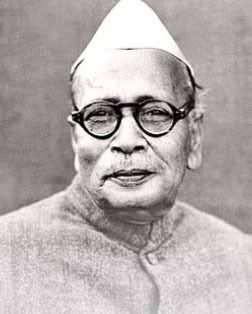
Anugrah Narayan Sinha (18 June 1887 – 5 July 1957), known as Bihar Vibhuti, was an Indian nationalist politician, participant in Champaran Satyagraha, Gandhian, and one of the architects of modern Bihar. He served as the first Deputy Chief Minister and the Finance Minister of the Indian state of Bihar from 1946 to 1957. He was also a member of the Constituent Assembly of India, which was elected to write the Constitution of India and served in its first Parliament as an independent nation. He also held a range of portfolios including Labour, Local Self Government, Public Works, Supply & Price Control, Health and Agriculture. A.N. Sinha, affectionately called Anugrah Babu, was a close associate of Mahatma Gandhi during the freedom movement and worked with Bihar Kesari Sri Krishna Sinha to lead the Gandhian movement in Bihar. One of the leading nationalists in the Indian independence movement from Bihar after Dr Rajendra Prasad, he was elected as the Congress Party deputy leader in the state assembly to assume office as the first Deputy Chief Minister cum Finance Minister of independent Bihar, and re-elected when the Congress Party won Bihar's first general election with a massive mandate in 1952. He was born to Visveshwar Dayal Singh on 18 June 1887 in a family of Poiwan village of the former Gaya district (later Aurangabad) in Bihar in the Rajput caste. His younger son Satyendra Narayan Sinha became chief minister of Bihar. He became the Secretary of the Bihar Students Conference founded by Rajendra Prasad and the Chanakya Society of the Patna College. In 1915 he was appointed Professor of History at the T.N.B. college in Bhagalpur where he remained until 1916.n 1917, heeding the call of Mahatma Gandhi to the nation, he left his flourishing law practice to join the Champaran Satyagraha movement. The Champaran experiment formed a vital chapter in the development of the Gandhian method in India and he was catapulted to the national stage. He served as a teacher in Bihar Vidyapeeth founded by Rajendra Prasad for motivating young meritorious youths. Among his first students was young Jayprakash Narayan. In 1922 he organized the Gaya Congress. In the following year he became one of the General Secretaries of the All India Congress Committee (AICC). When Rajendra Prasad was elected Chairman of Patna Municipality, Sinha was elected Vice-Chairman. As he was soon elected Chairman of the Gaya District Board, he resigned. He was the pivotal force behind the Civil Disobedience Movement led by M K Gandhi, in the year 1930 which is considered an important milestone in the history of Indian Nationalism.